
Introduction
The microscope is one of the most remarkable inventions in scientific history. It has completely changed how humans understand life, matter, and the hidden structures of the natural world. By allowing us to see objects that are invisible to the naked eye, microscopes have opened doors to discoveries in biology, medicine, chemistry, physics, and technology.
From school laboratories to advanced research centers, the microscope remains an essential scientific tool. Its role in discovering cells, diagnosing diseases, and supporting innovation makes it a cornerstone of modern science.
What Is a Microscope?
A microscope is a scientific instrument designed to magnify extremely small objects so they can be observed clearly. It uses lenses or advanced technologies such as electron beams to produce enlarged and detailed images of microscopic structures.
The word microscope originates from Greek:
- Mikros meaning small
- Skopein meaning to observe
- Together, the term literally means “to observe small things.”
Brief History of the Microscope
The development of the microscope began in the late 16th century. Early microscopes were simple devices with limited magnification, but they laid the foundation for major scientific break throughs.
- Robert Hooke discovered cells while observing cork tissue.
- Antonie van Leeuwenhoek was the first to observe bacteria and microorganisms.
These discoveries revolutionized biology and gave rise to microbiology as a scientific discipline.
Main Parts of a Microscope
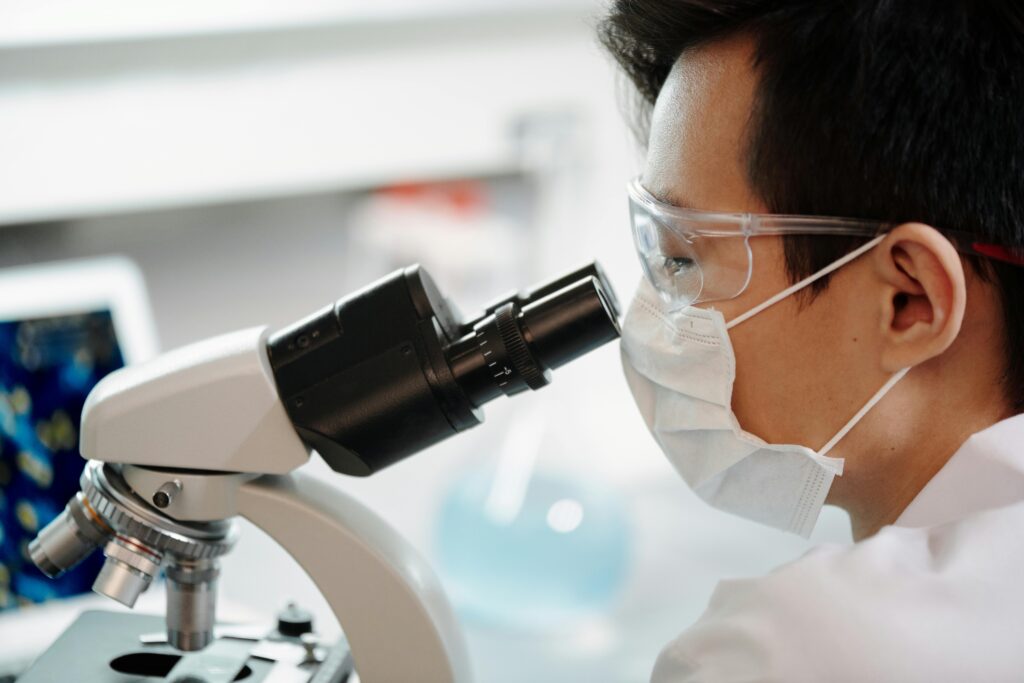
A standard compound microscope consists of several key components:
- Eyepiece (Ocular Lens): Used to view the specimen
- Objective Lenses: Provide different magnification levels
- Stage: Holds the slide securely
- Light Source: Illuminates the specimen
- Adjustment Knobs: Help focus the image
- Arm and Base: Support the microscope structure
Each part plays a vital role in producing a clear and accurate image.
Types of Microscope
1. Compound Microscope
The compound microscope is the most commonly used microscope in schools and laboratories. It uses multiple lenses to achieve higher magnification.
Common uses:
Observing plant and animal cellsStudying bacteria and fungiEducational laboratory work
2. Simple Microscope
A simple microscope uses a single lens, similar to a magnifying glass. While its magnification is limited, it is useful for basic observations.
3. Electron Microscope
An electron microscope uses electrons instead of light to achieve extremely high magnification and resolution.
Main types include:
- Transmission Electron Microscope (TEM)
- Scanning Electron Microscope (SEM)
- Uses:
- Studying viruses
- Examining cell organelles
- Nanotechnology research
4. Stereo Microscope
A stereo microscope provides a three-dimensional view of solid objects and is widely used for dissection and inspection tasks.
5. Digital MicroscopeA digital microscope displays images on a computer or screen and allows easy image capture and sharing, making it ideal for education and presentations.
Uses of Microscope in Different Fields
Microscope in Biology
The microscope in biology is essential for studying cells, tissues, and microorganisms. It helps scientists understand vital life processes such as cell division and metabolism.
Microscope in Medicine
In medicine, microscopes are used to:Diagnose diseasesAnalyze blood samplesIdentify bacteria and parasitesSupport cancer research
Microscope in Education
Microscopes play a key role in education by improving practical learning and encouraging curiosity among students.
Microscope in Forensic Science
Forensic experts use microscopes to examine:Hair fibersBlood stainsFingerprintsTrace evidence
Microscope in Industry
In industries, microscopes are used for:Quality controlElectronics inspectionMaterial testing
Importance of Microscope in Science
The importance of the microscope lies in its ability to reveal details that cannot be seen otherwise. It has:
- Expanded scientific knowledge
- Advanced medical diagnosis
- Supported innovation and research
- Improved accuracy in experiments
Without microscopes, modern science would not be possible.
Advantages of Using a Microscope
- Allows observation of microscopic objects
- Increases research accuracy
- Essential for medical and biological studies
- Enhances learning and discovery
Limitations of Microscopes
Despite their benefits, microscopes have some limitations:
- Advanced microscopes can be expensive
- Proper training is required
- Sample preparation may be time-consuming
Future of Microscope Technology
Modern microscope technology continues to evolve with innovations such as:
- AI-assisted imaging
- Super-resolution microscopy
- Portable digital microscopes
- 3D imaging systems
These advancements promise even greater discoveries in the future.
Conclusion
The microscope is one of the most powerful tools ever created by science. From discovering cells to diagnosing diseases and supporting technological advancements, it continues to shape our understanding of the microscopic world. As technology advances, microscopes will remain at the heart of scientific progress and education.